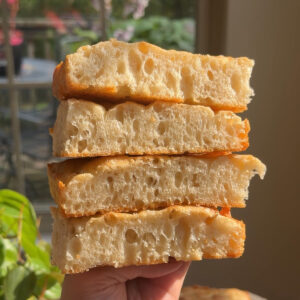
Sourdough Discard Focaccia
Airy, open-crumbed sourdough discard focaccia with a crisp, golden bottom and plenty of olive oil; made same-day or, for the best flavor, with an overnight rest.
Equipment
- Digital kitchen scale
- Large mixing bowl
- Dough whisk or wooden spoon
- Metal 9x13-inch baking pan
- Wire cooling rack
Ingredients
Focaccia Dough
- 360 g warm water about 90–100°F (1½ cups)
- 100 g sourdough discard preferably 100% hydration (about ½ cup)
- 7 g honey 2 teaspoons
- 6 g instant yeast 2 teaspoons
- 450 g all-purpose flour 3¾ cups
- 10 g fine sea salt 1¾ teaspoons
- 25 g extra virgin olive oil 2 tablespoons
For the Pan and Topping
- 3 –4 tablespoons extra virgin olive oil divided
- Flaky sea salt
- Fresh rosemary optional
Instructions
- In a large bowl, whisk together the warm water, sourdough discard, honey, and instant yeast. Add the flour and salt. Mix with a dough whisk, wooden spoon, or your hands until no dry flour remains. The dough will be very wet and sticky; this is intentional.360 g warm water, 100 g sourdough discard, 7 g honey, 6 g instant yeast, 450 g all-purpose flour, 10 g fine sea salt
- Cover the bowl and let the dough rest for 15 minutes.
- Drizzle the 25g olive oil over the dough. With damp or lightly oiled hands, grab one side of the dough, stretch it upward, and fold it over itself. Rotate the bowl and repeat on all four sides. Cover and rest for 15 minutes, then repeat the stretch and fold process. Repeat once more after another 15 minutes, for a total of 3 sets of folds. The dough should become smoother and more elastic with each round.
- Cover the bowl and allow the dough to rise at warm room temperature for about 60–90 minutes, or until noticeably puffy and increased in volume by roughly 50–75%.
- Generously coat a metal 9x13-inch baking pan with about 2 tablespoons olive oil. Gently transfer the dough to the pan. Flip it once so both sides are lightly coated in oil. Using oiled fingertips, gently stretch the dough toward the corners of the pan. Don't force it; if it springs back, let it rest for 10–15 minutes and then stretch it again.25 g extra virgin olive oil
- Cover the pan loosely and allow the focaccia to rise for another 45–75 minutes, until very puffy with visible bubbles beneath the surface. Toward the end of the rise, preheat the oven to 425°F (220°C).
- Drizzle another 1–2 tablespoons olive oil over the surface. Coat your fingertips in olive oil and press them firmly into the dough, all the way toward the bottom of the pan, creating deep dimples across the surface. Sprinkle generously with flaky sea salt and fresh rosemary, if using.3 –4 tablespoons extra virgin olive oil, Flaky sea salt, Fresh rosemary
- Bake for 23–28 minutes, or until the focaccia is deeply golden brown across the top and crisp around the edges. For the best texture, don't pull it when it is merely pale golden; the deeper color gives you that crisp exterior and chewy interior.
- Let cool in the pan for about 5 minutes, then transfer the focaccia to a wire rack so the bottom stays crisp. Drizzle with a little additional olive oil before serving, if desired.
Notes
Overnight option (recommended): After completing the stretch and folds in step 3, cover the bowl and refrigerate the dough for 8–24 hours instead of doing the same-day rise in step 4. The next day, transfer it to the generously oiled pan and let it sit at room temperature for about 1½–2½ hours, until very puffy and bubbly, then dimple, top, and bake as directed. This is my preferred way to make this focaccia; it gives you more flavor and a lot more flexibility.
The dough should be sticky: Don't add additional flour just because it looks much wetter than a standard bread dough. That higher hydration is what helps create the big, irregular holes and light interior.
Use a metal pan if possible: It conducts heat better than glass and gives you a dramatically better crispy, golden bottom.
Don't underproof the second rise: This is probably the biggest difference between dense focaccia and beautifully airy focaccia. You want the dough to look almost jiggly when you shake the pan.
Be generous with olive oil: Some of it looks excessive before baking, but that's what essentially fries the edges and bottom of the focaccia.
Nutrition
Calories: 168kcalCarbohydrates: 31gProtein: 4gFat: 3gSaturated Fat: 0.4gPolyunsaturated Fat: 0.4gMonounsaturated Fat: 2gSodium: 326mgPotassium: 45mgFiber: 1gSugar: 1gVitamin C: 0.01mgCalcium: 7mgIron: 2mg
Tried this recipe?Let us know how it was!
